Time Spent with Cats

© Time Spent with cats 2019
My Life In Cats…
On cats, photographs, family, the stories we tell about our
lives, and the healing power of the love of a good cat…
‘I have measured out my life with coffee spoons’, wrote TS Eliot in ‘The Love Song of J. Alfred Prufrock’. I’m no literature buff (truth be told, I’ve just found out that I’ve been wrongly attributing that line to Philip Larkin for the last few decades) and neither know nor care what Mr Eliot himself intended by that line, but I’ve always liked it. It resonates with me, I think, because it fits conveniently with my personal theory that each of us has - probably needs - a way of measuring out our life. I don’t mean The Big Milestones between cradle and grave, because they pretty much map themselves out. I mean the in-between time, the ordinary; the uneventful bit that gets us from milestone to milestone unnoticed. I mean, I suppose, the bit that happens while John Lennon thinks you’re ‘busy making other plans’. Although I might like my own life to be measured out with something more poetic, if I’m honest I know I measure it out with cats. They’ve been a constant and dominant presence in my life from (give or take a day or two) the moment of my birth, and they’ll no doubt continue to feature just as prominently until the moment I eventually check out. There’s a long feline chain weaving its way back between and around my Big Milestones, tails entwined and paws outstretched. Make of that what you will, amateur psychiatrists. I don’t like having to pick sides on the cats vs dogs issue (which has always seemed to me a bit like having to decide whether you prefer food or drink) because I love dogs too, but I am undeniably a ‘Cat Person’. That’s not all I am, of course, and I’d like to think that at least some of the people who’ve known me have a much more three dimensional view of me than that, yet I fear that if you rounded them all up for a mass game of word association, a fair proportion would hear my name and reflexively say ‘cats’. Ah well. It is, as they say, what it is. Of course, they weren’t my story. Not really. They were my mother’s story. Hers to remember and tell, to embellish or edit; but as children we selfishly claim our parents’ lives for our own and can’t conceive that there might be a dividing line. I claimed her photos for my own too as soon as I could, becoming the custodian of the old photos from the maternal side of the family. Those photos helped to bring the past to life and flesh out the stories, and cats feature heavily in them. There are well composed almost-portraits of cats - my mum’s first husband was a professional photographer, albeit of industrial processes and machinery rather than cats, although he evidently used (or ‘wasted’, in my mother’s words) a lot of time and film taking pictures of cats in his spare time. Then there are informal shots of cats playing, sitting, snuggling, leaping, climbing and sleeping; doing all the things cats do. Sometimes they’re with people I recognise as actual or possible relatives but more often with people I’ve never met and don’t know if I’ve even heard of; I may not know the people but I can put a name and at least a brief biography to most of the cats. Those photos and stories are a record of my mother’s life before me; her life also measured out in cats, although I know she would have begged to differ on that. It amuses, and sometimes bemuses me a little too now, that mum told me in great and vivid detail about her past cats many years before she ever mentioned the existence of the first husband, to whom it turned out she’d been married, mostly happily, for nearly 20 years. That’s impressive editing. In fact, it’s such impressive editing that I never really noticed, or at least wasn’t particularly bothered by, any gaps in the story. I don’t even remember asking who was behind the camera taking all the photos. My mother had neither interest nor skill in taking photos - photography, in her view, being a total waste of time and money - and, when pressed to so, was a renowned chopper-off of heads and feet, so it clearly wasn’t her. In the pictures for which she must have been responsible, I don’t remember querying the unknown man - top of his head or a random bit of a limb missing - smiling at the camera, often sharing the frame with a similarly afflicted cat. I don’t recall wondering why she never mentioned a man between her teenage boyfriends and, getting on for three decades later, my father. Perhaps I’m over-analysing things and looking at history through a very 2019 filter, but I wonder now whether she found it easier to talk about cats than to stir up the emotions that inevitably go with the breakdown of a marriage, (and hers must have still been fairly fresh at that point). When she did eventually drop the husband, casually yet a little cautiously, into conversation, I was a bit thrown and not quite sure how to react. I remember trying for nonchalance despite bursting with questions and being a tiny bit indignant too that she could have lived a whole different life in a different place with a different surname and without me in it. I’ll be honest, I think it gave her a touch of rakish glamour in my eyes too, (this being the 1970s and me not having met many – probably any - divorced people up to that point). Anyway, with the ex – who actually turned out to be an interesting character in his own right - now firmly on the table, he and his large extended family could be edited back into my mum’s anecdotes and memories, and duly were. New characters popped up in old stories and previously nameless bit-part players in photos were assigned names and meaningful roles. Now there was context to the stories and the cats and the life, even though they’d been no less interesting before for the lack of it. The missing pieces were restored even though I’d never really known they were missing. My theory, sitting here with my twenty first century armchair psychiatrist hat on, is that my mother found there was safety in cats; that telling their stories made it easier to process her own, to parcel up her old life and get on with her new one. As an adult, I can see that the new life she was busy getting on with was a rapid flurry rather late in life of new town, new husband, new house, new job, new friends and new baby and then just weeks before I was born, the death of her own father. That’s a lot to process; a lot of things to balance into a new equilibrium. For all her claims to be a ‘a dog person really’, it was in a cat that my mum had sought, or at any rate found, solace immediately after splitting from the first husband. Staying temporarily with friends, who fortunately themselves lived with an assortment of furred and feathered friends (which I, a few years later in Christmas and birthday thank you letters, would always refer to as ‘the menagerie’), and her daily walk to work took her past a pet shop. One evening, there was a tiny black and white kitten in the window doing the ‘Silent Miaow’ - the secret weapon in any cat’s armoury – at her. Even my mother, who I always knew as iron-willed to the point, sometimes, of hardness, was defeated. Five minutes later she was a few pounds poorer but richer by one kitten, carried home in her handbag and named Dinah. I’ve always loved that anecdote. I loved it before I knew its true context, when it was just a story about an ordinary woman on an ordinary workday, unexpectedly charmed by a kitten. I loved it even more once I knew the context; now it’s really a story about a woman who’s cut herself adrift from her marriage (in a time when women, on the whole, still didn’t do that) and with it her old life, finding comfort in the familiar, which happens to be the feline. It’s a story that told me more about my mother than she was ever willing to reveal about herself. It’s also a story about what The Love of A Good Cat can do for you, and I’m a great believer in that. Dinah, meanwhile, lived to be sixteen and three quarters - the fraction is very important when you’re a child, of course. Just a few short years - but a whole whirlwind of change for my mother – later she became the first cat in my own life story, and she’s there in my baby photos, determined not to let some new human child steal her limelight. My mother used to tell me that when she was thinking of moving to another town to marry my father, he announced proudly ‘I’ve got you a cat’. She always gave the impression that he thought this was what clinched the deal, although in her telling the thing that actually did clinch it for her was my father’s brown eyes and demonstrable proficiency at DIY. I’m digressing slightly here, but by her own admission, her two screening questions for any potential mate were ‘can you do DIY?’ and ‘can you take criticism?’ Ever the pragmatist, my mother. Anyway, what my dad meant was that he had been adopted by an elderly, streetwise stray cat called Sooty. Sooty makes an appearance in a few of my baby photos too, although always in the background overshadowed by Dinah. History tells that the two cats struck up a mutually beneficial partnership, with Sooty playing Artful Dodger to Dinah’s Fagin. I don’t really remember Sooty because he disappeared before I was old enough to register that my father was sad or to know that he was going out pounding the pavements every night, searching in vain for his lost friend. You’ll have gathered by now that, consciously or otherwise, my mother had managed to pick herself another Cat Person for a husband. With people my dad was quiet, undemonstrative and - I now realise - painfully shy, but to cats he was some kind of superstar. Catnip in human form. When I was about seven, my mother and I went away with my aunt for a few days. On our return, dad reported that on the night we left, 5 stray cats (none of them regulars) had turned up in the back garden, evidently expecting to be fed. He duly obliged, of course. Looking back, my dad opted out of quite a few trips and visits to ‘stay and look after the cats’, which annoyed me at the time because I wanted him to come with us, do things, tell me his story. I now suspect he too was finding there was safety in cats. I think they offered both a convenient excuse and a comforting, accepting presence for a shy man who didn’t want to talk to people or think about his past. Cats loved him, and despite his claims to have previously been a ‘more of a dog person’, he clearly loved cats. Where my mother had stories and memories and photos about life before me (and, let me point out for the sake of balance that they weren’t just about cats; there were plenty of memories and stories involving humans too), my father was a closed book. I hassled him constantly for details or pictures, but aside from a handful of brief facts about his childhood and some surprisingly fond reminiscences about his time in the army during the war, he revealed nothing. It was as if he’d arrived in the present fully-formed. Most of the things I now know about him - still not a huge amount - I learned from my mother, and mostly not until after his death. It was only then that she handed over the old photographs from his side of the family, that I’d been itching to get my hands on for years. Finally I had something of his story, but by then it was too late to ask questions or connect dots and I think, more than likely, that was deliberate. They are forever pictures without context, and give little clue as to the life or the man. There are ancient, posed photos of solemn looking ancestors, two or three formal photos of my father’s much older siblings and then one shot of him as a boy, smiling, with a dog I know to be called Jip and suspect to be the basis of his unconvincing claims to be ‘a dog person, really’. The existence of Jip was the one thing from his childhood that he would ever talk about, and even then only after a few drinks and a lot of pestering and never in detail. From the little I do know now of his family’s religion and behaviour, I suspect the story, and Jip, had a sad ending that he did not wish to recall. Piecing things together as far as I can, again thanks to my mother’s superior interrogation skills, I do know that my dad’s childhood and young adulthood were unhappy and shaped by early tragedy in a time long before it became good, and more or less mandatory, to talk. A very long time before self-care and sharing and support and healing and closure came into being. With adult eyes I see his secrecy, that irritating refusal to tell me about himself and his life, as nothing more than the understandable product of sadness and maybe a touch of self- preservation. I factor in, too, the pragmatism of a generation who simply had to get on with things, however they felt, because there was no alternative. I don’t know anywhere near enough of my dad’s story and I never will, but I now know enough of the context to see that it’s the story of a man determined to escape an unhappy past who, quite late in life, finally gets a shot at happiness. I don’t know whether his shot at happiness paid off and made him happy, although I remember him being cheerful at least some of the time - singing, laughing, dancing. The photos certainly seem happier after I start to appear in them, and I don’t think that’s just my ego talking. For one thing, he starts to appear in them himself; no longer always the one behind the lens looking in. He is now part of something; my mother told me that a family was the one thing my father had always wanted above all else. Cats feature heavily in the photos, as do I – no move I made from birth to teens went undocumented - then at some point, the photos change from the black and white shots taken and/or developed by my father to colour shots taken by me. My poor mother had hit the jackpot and also managed to produce a child who loved ‘wasting’time with cameras too! As the family photographer I was never short of more or less willing feline subjects because we never had fewer than two-and-a-bit cats at any time, the ‘bit’ being the inevitable stray who hadn’t quite moved in yet but was working on it. Often we had a lot more than that – I think we once, briefly, maxed out at seven - despite my mother’s mantra ‘no more cats’, proclaimed often and always to no avail. We never needed to ‘get’ a cat; the cats came and ‘got’ us. I remember them all - names, personalities, characters and quirks. I know which cats we had when, and I know the timing of events by the cat or cats within whose lifetime they happened. Some people remember where they were when John Lennon was shot or when Elvis died; I can tell you which cats we had at the time. A quick count-up tells me I have shared my life with twenty official feline family members plus others who made brief appearances or hangers-on who didn’t officially move in and later, other people’s cats who were in my life for a short while. You’ve indulged me this far so I’m going to assume a reasonable level of reader commitment here and list them: Dinah and Sooty, obviously; Stinker, whose name was harsh but, as I recall, fair; Johnny, whose party trick was to roll over on command; Sir Primrose le Pussy-Cat, whose title was bestowed by my mother after his first visit to the vet, to make up for his misgendering and enable him to hold his head high in the cat community. It worked and he did. Tibby and Toby were both black and white, the former loved food and the latter loved a good scrap so was a frequent flyer at the vet and expert in removing the ‘cone of shame’. Bella was a pretty male tabby who lived as a she (sexing kittens, as you’ll have gathered, was never a strong point in our family) and this time there were no compensatory attempts to elevate her to the nobility. In my teenage Goth phase – a long time before identity politics - I briefly tried to garner support for re-launching Bella as her true masculine self by changing her name to ‘Bela’ (I’d listened once too often to the Bauhaus song about Bela Lugosi, I think) but the idea met with zero support and both the idea and the Goth phase were mercifully fairly short-lived. Bella remained a ‘she’. We had a run of sweet-natured ginger cats: Ginge, then One-Eyed Ginge (imaginative naming was not the family strong point either) and then Theodore, who inexplicably got lucky in the name stakes. Theo was one of the very few cats we set out to acquire, not to mention the only kitten we ever correctly managed to identify as male, and he was (to my surprise) my mother’s idea. She announced one day that it would be a good idea to get a kitten ‘for your grandma’, who had by then come to live with her. I was beside myself with delight; Grandma didn’t appear to know she’d wanted a kitten but seemed equally happy although she rarely got his name right. The poor cat was known to her, inter alia, as ‘Thermidore’, ‘Thermal’ and ‘Thermogene’, but then she frequently called me by the name of one or other of my cousins or cats, so he wasn’t the only one to suffer by any means. It might have been a surprise at the time but, looking back, I don’t think it’s any coincidence that the idea of a kitten popped up at that particular point. My mother had, recently and within a fairly short time, lost a husband, seen a daughter off to university, developed her own health problems and found herself unexpectedly in the role of carer for her own elderly mother - a role she didn’t want and wasn’t equipped for, particularly at that time. She was left alone to care for a woman she loved in her way but with whom she had never felt much of a connection, and who wouldn’t need some comfort in that situation? Where better to find it than in tried and tested feline form? And if ever a cat was up to the task, it was Theodore. He was an adorable, intelligent kitten who grew to be a wise and loving cat and lived to just short of his nineteenth birthday. Darius was named after the conman Darius Guppy, because he shamelessly conned his way into the household by exploiting his physical likeness to, at various points, both Declan and Dermot (to be honest, I think we were conditioned by that point to see any vaguely black and white cat and automatically feed and water it ). Smokey, a beautiful blue-grey cat, auditioned us for years, inching gradually closer and taking his time to decide whether he could trust us, while Worried Jim wasn’t bothered about moving in and came round every day for the sole purpose of getting stoned out of his mind on catnip. He spent his days prone and drooling in the catnip patch, occasionally popping inside the house to steal a catnip toy to take away with him, usually getting distracted and abandoning it halfway down the garden path. We never knew why he looked so worried all the time, but he was always a lot more chilled when he left. Big Fat Charlie hated women but loved men. He soon realised the error he’d made in moving into an all-female household and immediately began working on a male neighbour two doors down. Once his mark was sufficiently softened up, he shamelessly dumped us and moved in there, but continued to rub our noses in our loss by popping back regularly for snacks, naps or just to pick a fight with anyone - feline or human. Jet was a small, completely deaf and very loud black cat who quickly became the boss, largely because she was handy with her fists. She once used them on Big Fat Charlie (at least three times her size), taking him completely by surprise and knocking him off his feet. He’d made the mistake of thinking they were in for the standard cat fight - half an hour of fluffing up, glaring and howling followed by a face-saving slow creep away by both parties - but Jet made her own rules and that was the first and last time he tried to pick a fight with her. Tigger was a hurricane in feline form, as irrepressibly bouncy as the name suggests, while Harvey was a tolerant, gentle ginger cat and frequently the one bounced upon. Harvey had visited occasionally as a curious, friendly and well-cared- for youngster then vanished. He returned a few years later; older, wiser, terrified of people and with a horrific open wound across his shoulders and neck. With time and patience he came to trust me, moved in, and slowly started to recover from the trauma of his middle years. I remember the very first time I ever saw him playing, chasing a leaf in the wind, unaware that he was being watched. I knew then that at last he felt safe and content. I realised too that he wasn’t the only one who finally felt safe and content. His recovery had coincided with my recovery from a series of painful events in my own life. We had helped each other through and come out the other side, a bit battered, but o.k.. And that’s been a recurring theme in my own life, my own story. Cats have been with me in good times and bad. Whatever has happened – happiness and sadness, success and failure, good health and bad, love and loss, they have stayed close with their intuition, comfort and acceptance. Like each of my parents, I’ve found safety in cats and been saved (more than once) by the love of a good cat. I am firmly a rationalist but I do allow myself one unscientific belief, which is that cats come into your life when you need them most. Sometimes it’s deliberate, although not necessarily conscious - like my mother and Dinah. More often, it’s completely outside your control; the cat appears and you have little or no say in the matter. Sometimes your time of greatest need coincides with the cat’s - like Harvey. You’ll think you’re the one doing all the work, building the trust, doing the rescuing, but you’ll be only half right, because sometimes you’ll need them a lot more than they need you, even if you don’t know it or admit it. But when it happens, don’t fight it. Never fight it. If a cat chooses you, give in gracefully because it will enrich your life in ways you don’t expect and help you through whatever it is you’re going through. It might do it gently, all calm comfort and soft purring snuggles. It might do it with tough love, by bossing you into a strict routine and keeping you firmly under the paw. Or it might do it simply by reminding you that you can smile even when you didn’t think there was anything left to smile about; that it’s fine to laugh even if your life is going to pieces around you. There are as many modus operandi as there are cats and humans. Your story will be different to mine, which is different to my mother’s and my father’s. They can’t cure everything, of course; cats are not miracle workers even if they might like to believe their own hype, but let them into your life and it will never be a lonely or dull one, and then when you look back and tell your story you’ll see how they helped to shape both it and you, how they helped you make it from Milestone to Milestone. And one day - a bit like Harvey chasing his leaf in the wind - you’ll feel the sun on your face and the grass beneath your feet and you’ll look across at your feline friend (who will most likely be dozing in the shade nearby while pretending to supervise you) and you’ll find yourself thinking ‘You know what? Life may not be perfect; life may never be perfect, but we’re here and it’s fine. We’re o.k..’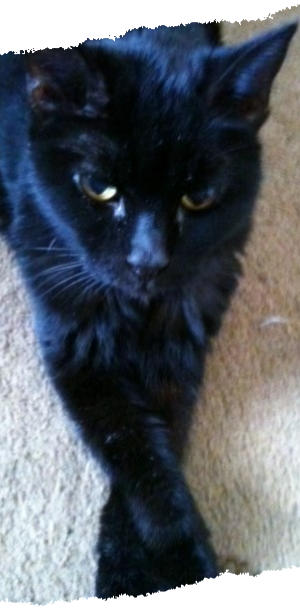
Privacy
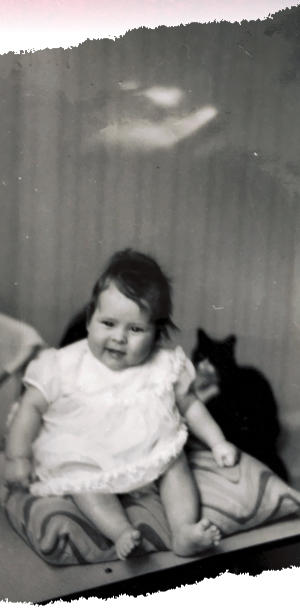
Above: me, being ‘photobombed’ by Dinah.
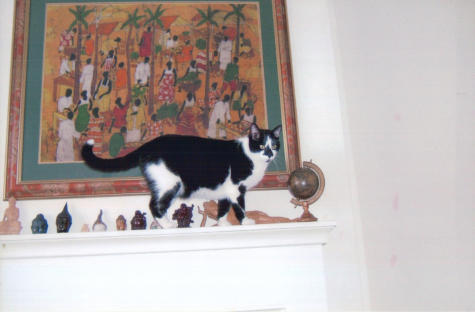
Above: Jet. A feisty wee Scots lassie (she
began life in Edinburgh) and - like a good many
of her countrywomen that I’ve known - definitely
not one to be messed with!
Mewsings
Occasional writings about, inspired by, or
at least vaguely related to, cats.
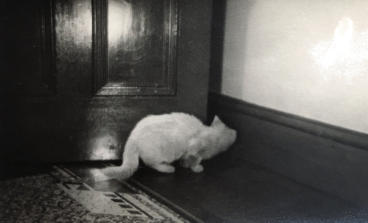
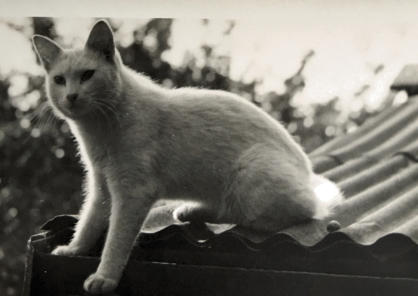
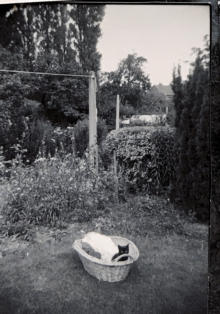
Above and left: Figaro
Right: Rastus
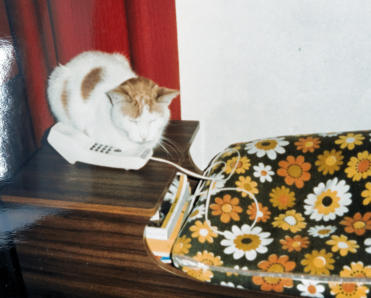
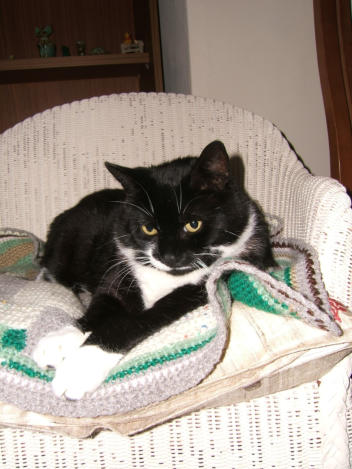
Left: Give a cat a
knighthood and he’ll get
big ideas: Sir Primrose,
waiting for an important
call, some time in the
decade that style forgot.
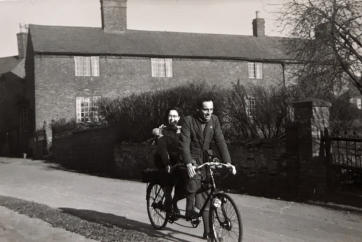
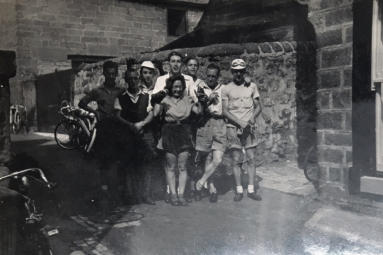
Below: A photo I particularly like of my mum with her cycling club - just to
prove there were some non-cat-related stories and photos. Apparently my
grandma was horrified by those shorts and told my mum ‘you’re showing
everything you’ve got!’ which caused my mum great amusement.
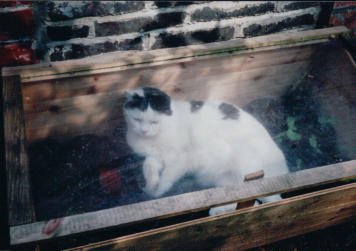
Right: Baby-faced Declan
plotting dastardly deeds in the
cold frame and/or sabotaging
my seedlings.
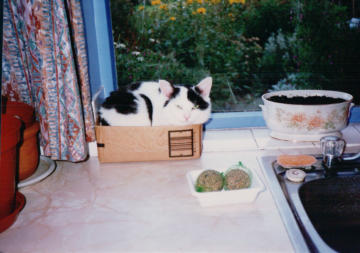
Below right: arch-conman
Darius, demonstrating the
well-known ‘If I fits I sits’
principle.
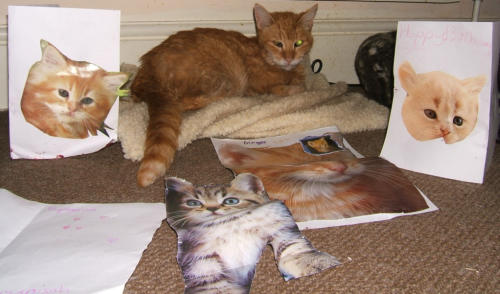
Above: Theodore, holding court on his 18th birthday, showing off birthday cards
made for him by a friend’s children
Below: Tigger, who was very nearly named Dennis because of the frequency
with which his antics provoked the phrase ‘that cat’s a menace!’
Above: Big Fat Charlie, who tipped the scales at 22lb and
had a ‘three strokes and you’re out rule’ for women, which
he enforced rigidly with NO EXCEPTIONS. Men, meanwhile,
were allowed to fuss him, rub his chin and tickle his tummy
as much as they wanted. We had a love/hate relationship -
I loved him; he hated me.
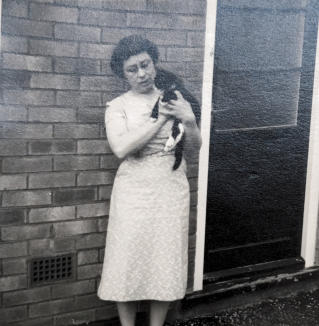
Below: my mother with Dinah, the kitten who
captured her heart and below, with Theodore, who
was acquired ‘for your grandma’.
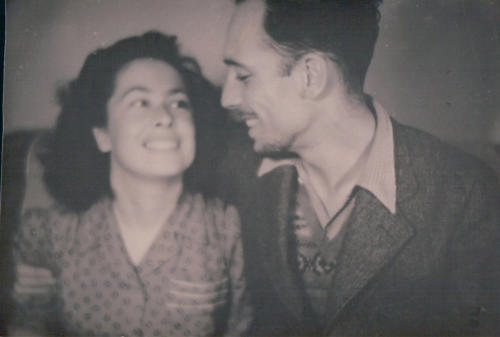
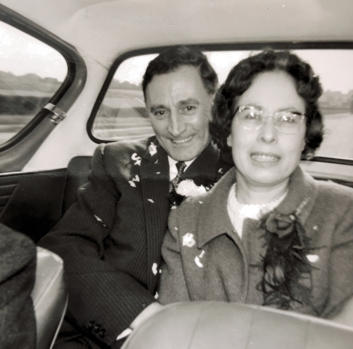
Above: my parents on their wedding day; was it the lure
of another cat that clinched it, or did she fall for the
brown eyes and killer DIY skills? We’ll never know.
Above: Bella in the dolls’ house my dad built (yeah,
check out those famous DIY skills!). It was a huge,
floor-to-ceiling affair and after it ceased to be a dolls’
house it - perhaps not surprisingly - became a cat
house for many more years.
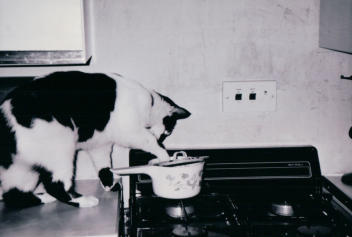
Left: Dermot, caught red-
handed.
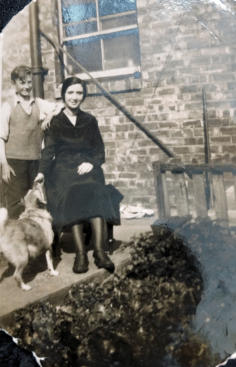
Above: my father with Jip and below left, with me
L
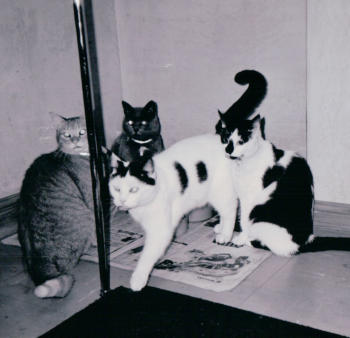
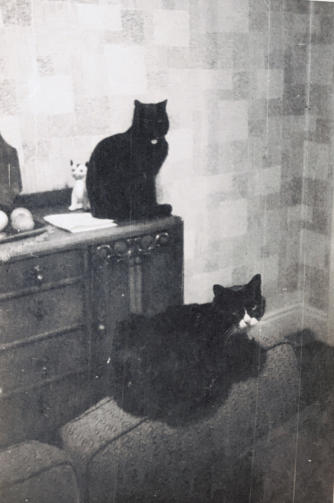
Above: Dinah and Sooty, probably plotting. See that
china cat ornament behind Sooty? I got the blame for
breaking that (along with the rest of my mum’s
collection of china cats). I think I might have been
framed.
Left and below: my mum with her first husband
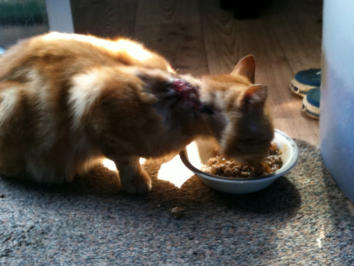
Above: Harvey reappeared after a lengthy absence, thin, fearful and with a huge open
wound.
Right: a few years later, a happy, healthy and handsome Harvey demonstrates one of
the reasons why drugs are bad
Left: Good thing there was
no Tripadvisor back then.
Theodore, Smokey, Declan
and Dermot, finding - as so
many cats do - that you just
can’t get the staff.
It’s not my fault I’m cat way inclined, as you might say (sorry!). Nor it is at all
surprising, since both my parents were cat people, although if you’d asked
either of them they would have told you that they were ‘more a dog person
really’, particularly my mother - who had an awful lot of memories,
anecdotes and stories about cats for a supposed ‘dog person’.
As a child I loved hearing those stories and felt I knew the cats in them as
well as I knew my own, even though each set of nine lives was over way
before my own began. Even now, decades later, I remember a lot of the
starring characters: Figaro, the handsome and adored white cat named by
my mother’s first husband, who thought it would be amusing to stand at the
back door calling ‘Figaro, Figaro, Figaroooo…’ in his best approximation of
an operatic tenor (as, apparently, it was - the first time); Rastus, the ninja
who amused himself by leaping from the banister onto the shoulders of
guests, particularly those who didn’t like cats, and draping himself there like
a fur stole possessed; Tinkerbell, a huge and terrifying tom cat who struck
fear into the hearts of my mum and her sisters (one of whom had been
responsible for his name, so maybe there was a link there) but played the
cute little kitty with my grandma. Along with various others, they were
brought to life on boring journeys and when I was ill, couldn’t sleep, or
simply pestered so much for a story that my mother gave in for a quiet life.
She was a good storyteller, and her stories were woven into the fabric of my
childhood. They felt to me like part of my own story.
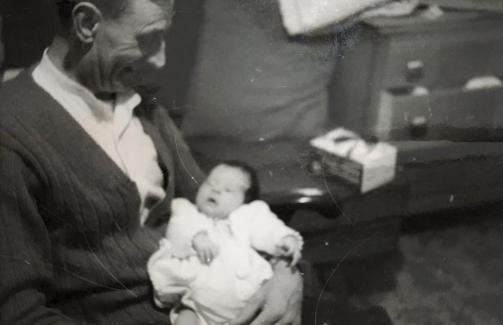
It was just as well he did, too, because throughout my childhood
we were adopted by a succession of cats. They were usually
elderly and mostly somewhat the worse for wear, and it was
almost always my dad who carried them to the vet for the
invariably expensive treatment they needed. He rarely bothered
with a carrying case or basket but simply carried the patient in his
arms, wrapped in a cardigan. Few cat owners in their right mind
would attempt that even on such a short walk, and my mother and
I used to get cross with him for risking it, but he carried on in his
own sweet way and always made it there and back without
incident. The various cats always seemed quite calm and happy
making the journey in his arms.
He was quite content to share his shed with cats too. He cut out a
cat door in it and placed boxes lined with newspaper on the
shelves so the stray cats of the neighbourhood would always
have somewhere warm and dry to go. That shed became a
hangout for generations of local cats (and it stank!). It became
‘The Cat Club’ in stories my mother made up for me and then in
stories I made up myself and games I played with my friends, and
even in the musical I wrote and performed with a friend at the age
of eight. Thankfully this was in a time before YouTube and no
recordings exist (although I do still have what I will charitably
describe as the score.)
The bond between cats and my dad made me, frankly, a bit
jealous as a child because they loved him more than they loved
me. Looking back now, again with the amateur shrink hat on, I
sometimes think that what I was actually feeling was that he loved
them more than he loved me. Now, that was manifestly untrue –
my dad was ridiculously and indiscriminately proud of every
unremarkable move this wonder-child made - but the cats had a
closeness and understanding with him that I never did. I never
really knew him and he, despite that unwavering pride and
adoration, never really knew me. I think my mother felt it too,
because when she was annoyed she would tell my father ‘you
care more about those cats than you do about me’. I don’t for one
moment think she was right, but I do wonder if he found it easier
to be himself with cats than with people, even his wife and child,
and to show his love.
Then there are group snapshots of smiling young men in
uniform. I now know – from my mother, whose interrogation
skills were far better than my own - that my dad enjoyed his
time in the army because it gave him a feeling of belonging and
the chance he’d been looking for to escape his oppressively
religious family. My mother believed he took great delight in
being the only willing conscript in a family of conscientious
objectors, and I hope she was right.
After the war come a couple of decades’ worth of the generic,
thoughtfully-composed shots marking out the keen amateur
photographer - consciously or otherwise my mum had gone
and got herself another husband who liked to ‘waste’ time with
cameras. There are occasional snapshots of unknown people
in unknown places, and smiling groups of people I assume to
be work colleagues, but my father is always the one behind the
camera and never the one in the picture. Always outside
looking in; quietly observing and thinking. Unlike the photos
from the maternal side of the family, which show happy people
enjoying a mostly happy life, my father’s photos have no sense
of joy or belonging or continuity; no real story. They are just a
series of disjointed and fading views of a disjointed and fading
history. His photo collection was one, I sense, kept more out of
a sense of duty and perhaps an inability, despite himself, to let
go of the very last link to the past, rather than out of any wish to
revisit or remember it.
He was fairly soon joined by Dermot and Declan, the
Kray brothers of the cat world, the latter faking an
expensive but suspiciously short-lived hip injury to
gain access to the household and then bringing along
his brother as a non-negotiable part of the package.
Declan had the face of an angel and the soul of Don
Corleone and was a notable thug and (literal) cat
burglar. Dermot specialised in canine intimidation;
more than once I was asked to remove him from a
neighbour’s porch where he had their dog cornered.
The brothers befriended some of the less savoury
human characters in the neighbourhood. Declan used
to visit a rather shady man with an abundant
knowledge of explosives who was widely believed to
have ‘connections’ of the sort you’d rather never
connect with; while Dermot was a regular visitor to the
local drug dealer, though for cuddles and wafer-thin
ham rather than illegal substances. When he died, his
friend the dealer brought round a sympathy card and a
small tree for me to plant in his memory. There’s more
than one learning point in there about books and
covers, I’m sure, but that’s for another day.
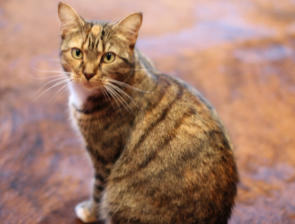
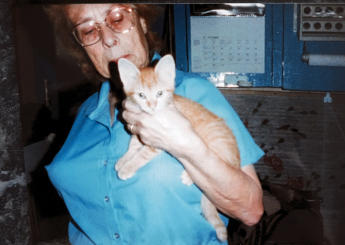
Above: Nelson, below: Princess Leia. My two
present owners. You’ll meet them later.

@UKTimeSpentWithCats